Vitamin D3 (The Structural Engineer)
🛠️ Technical Overview
In the architecture of midlife health, Vitamin D3 (cholecalciferol) functions as the structural lead on site.
It is the coordinator that tells your system how to handle one of its most crucial raw materials: calcium.
Without an efficient Vitamin D pathway, your body can import all the calcium it wants and still fail to deploy it correctly.
From an auditor’s perspective, any serious review of skeletal integrity, immune resilience, and long-term vitality has to begin with Vitamin D status.
🔍 The Auditor’s Findings: Key Functions
Bone Architecture Reinforcement
Vitamin D3 regulates the absorption of calcium and phosphorus from the gut, ensuring that the materials needed for bone maintenance and repair are actually delivered to the construction zone.
When this pathway underperforms, the body compensates by “mining” calcium from its own structural supports—your bones—gradually weakening the frame.
Over time, this can contribute to osteopenia, osteoporosis, and an increased risk of fractures, especially in the “Second Act” of life.
Immune System Site Security
Vitamin D3 also works as a key modulator of the immune response, fine-tuning how your internal security system reacts to threats.
Rather than acting as a blunt weapon, it supports a more intelligent, measured defence—strong enough to respond, but less likely to misfire.
In audit terms, it upgrades your security protocols, reducing the risk of both under-reaction to genuine threats and over-reaction in the form of chronic inflammation.
Hormonal Calibration and Genetic Oversight
Vitamin D3 behaves more like a hormone than a simple vitamin.
It interacts with receptors throughout the body and influences the expression of hundreds of genes involved in metabolism, cell growth, and immune function.
You can think of it as a systems engineer updating the “software” that controls your metabolic engine – adjusting performance parameters, stress responses, and repair protocols.
As a pro-hormone, it influences over 2,000 genes, effectively recalibrating the “software” that runs your metabolic engine.
📉 The Deficit Risk (The “Structural Crack”)
A deficiency in Vitamin D is often a silent risk factor, quietly undermining resilience until something gives way. The “cracks” can appear as:
- Chronic fatigue or low energy (engine stalling between tasks).
- Bone, hip, or lower back pain (load-bearing structures under strain).
- Muscle weakness and reduced physical performance (support beams losing tension).
- Frequent infections or slow recovery from illness (security system response lag).
Many midlife adults spend more time indoors, use high-SPF sunblock, or live at latitudes with limited year-round UV-B exposure. The result: your biological construction site is under-supplied with a critical regulatory asset, even if your diet appears adequate on paper.
📍 Auditor’s Recommendation
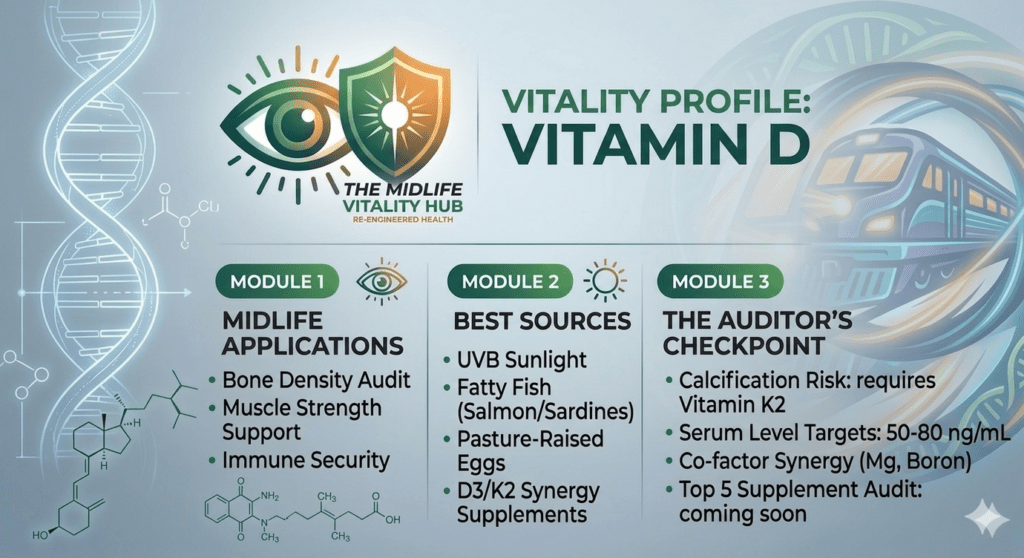
Target Range: Aim for blood serum levels between 50–80 ng/mL (125–200 nmol/L) for optimal structural integrity.
The Source: Prioritise UV-B synthesis (The Sun) where possible, supplemented by high-quality D3/K2 “co-factors” to ensure the calcium is delivered to the bones and not the arterial walls.