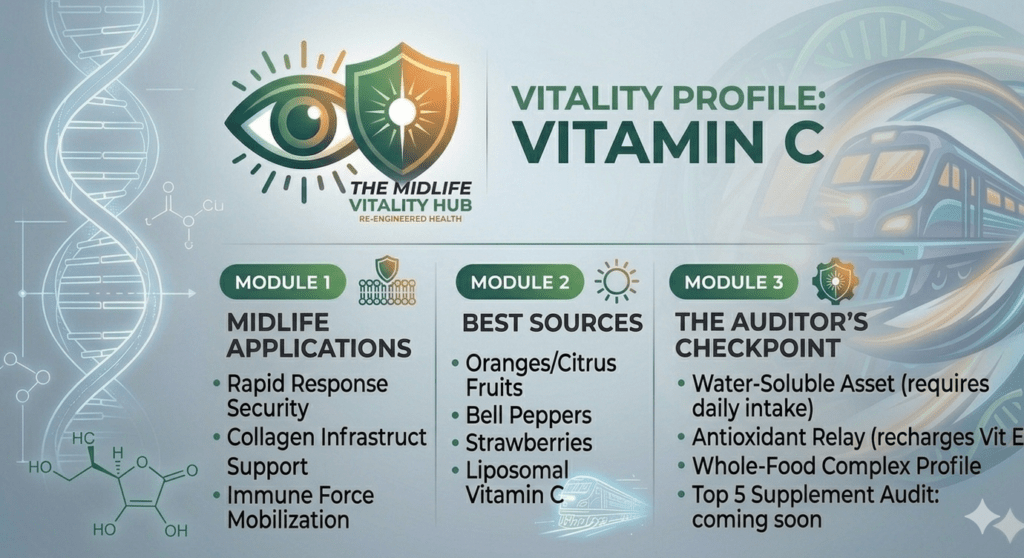
📋 The Manifest: Vitamin C (The Rapid Response Security)
🛠️ Technical Overview
In the clinical re-engineering of midlife health, Vitamin C (Ascorbic Acid) acts as the lead for Rapid Response Security.
Unlike many nutrients that can be banked in tissue reserves, Vitamin C is water‑soluble, highly mobile, and quickly spent under stress. That means it must be imported daily if you want your system to maintain a reliable front-line defence.
Its primary technical roles are the synthesis of collagen—the structural “glue” that holds your framework together—and the immediate neutralisation of oxidative threats in the body’s fluid compartments, including blood, lymph, and interstitial fluids.
Viewed through an auditor’s lens, Vitamin C is the emergency response unit that shows up first, stabilises the scene, and prevents small micro‑faults from escalating into full structural failures.
When the demand for repair, recovery, or infection control rises, your utilisation rate of Vitamin C spikes—and any gaps in supply become quickly apparent.
🔍 The Auditor’s Findings: Key Modules
Collagen Infrastructure Support
Vitamin C is the essential co‑factor for hydroxylation, the chemical process that cross‑links and strengthens collagen fibres.
This operation underpins the integrity of skin, ligaments, tendons, cartilage, and arterial walls. Without sufficient Vitamin C, collagen formation is incomplete—your structural “glue” loses tensile strength, and micro‑damage accumulates faster than it can be repaired.
In practical terms, that means joints feel less resilient, skin loses firmness, and blood vessels become more fragile under pressure.
Immune Force Mobilisation
Vitamin C plays a central role in mobilising the immune “security guards.”
It supports the production and function of white blood cells, enhances their ability to reach sites of infection, and improves their capacity to neutralise pathogens once they arrive.
It also contributes to the integrity of epithelial barriers—the physical “fences” lining the respiratory and digestive tracts.
When Vitamin C supply is robust, your immune system can respond rapidly and decisively instead of lagging behind the threat curve.
The Antioxidant Relay
Vitamin C is a key player in the Antioxidant Shield, working in close coordination with Vitamin E.
After Vitamin E neutralises a lipid‑phase oxidative threat, it becomes oxidised itself—effectively “off duty.”
Vitamin C donates an electron to regenerate Vitamin E, putting it back on active service.
This relay mechanism turns a single‑use event into a recyclable defence loop, greatly increasing the efficiency of your antioxidant network.
📉 The Deficit Risk (The “Infrastructure Decay”)
Because the system cannot meaningfully store Vitamin C, even shortfalls over days to weeks can begin to show up in the audit. A consistent lack of daily “shipments” may present as:
- Joint and tissue fragility (collagen breakdown in load‑bearing structures).
- Slow wound healing (repair crews deployed, but under‑supplied).
- Bleeding gums, easy bruising, or visible capillary damage (micro‑vascular failure in high‑stress areas).
- Increased susceptibility to colds or prolonged recovery from infections (sluggish rapid‑response security).
While full‑blown scurvy is rare in modern settings, mid‑level depletion is common—especially in individuals under chronic stress, high toxin exposure, or with diets low in fresh, whole foods.
📍 Auditor’s Recommendation
Technical Requirement: Fractionated Dosing
The body can only absorb a limited amount of Vitamin C at one time, and excess is simply excreted.
For best utilisation, smaller divided doses across the day generally outperform a single large bolus. From an engineering standpoint, this is about maintaining stable supply pressure rather than dumping all materials at once.
Prioritise Liposomal or Whole‑Food Sources
For maximum site absorption and sustained availability, prioritise Liposomal Vitamin C (which enhances uptake and may improve tolerance) or whole‑food complexes such as Acerola or Camu Camu.
These often arrive with natural co‑factors and bioflavonoids that support more efficient deployment.
The objective is simple: ensure your rapid response security team has a steady, 24‑hour flow of resources instead of sporadic, boom‑and‑bust deliveries.
In your midlife audit manual, Vitamin C is not just a “cold season” supplement—it is a daily operational requirement for structural integrity, immune readiness, and antioxidant resilience.